
Undergraduate Major
Bachelor of Science in Health Science - Pre-Master of Science in Athletic Training
Pennsylvania is home to professional sports teams, NCAA colleges and a strong healthcare network, offering plentiful internships, clinical placements and networking opportunities for students in athletic training degree programs. At Alvernia University, athletic training students benefit from these resources while gaining an education that combines hands-on experience, expert mentorship and a supportive community.
Career Outlook
Fast-Growing Profession
According to the Bureau of Labor Statistics, employment of athletic trainers is projected to grow 11 percent from 2023 to 2033, much faster than the average for all occupations.
Compensation
The median annual wage for athletic trainers in 2024 was $60,250.
Traditional Opportunities
After earning your MSAT, you can pursue a variety of careers in traditional practice settings including:
- secondary schools
- colleges and universities
- professional sports programs
- sports medicine clinics
Emerging Opportunities
You can also pursue careers in emerging practice settings, including:
- industry
- the military
- law enforcement
- physician practices
- performing arts

Program Overview
- Application Instructions
Through a rolling admission process, prospective undergraduate students — including first-year, transfer, and international students — may apply via the Alvernia web portal or The Common Application. To learn more about how to complete your application, please visit our application page.
- Financing Your Education
There are options to assist in financing your education and making the tuition affordable. Visit our Student Financial Services page for a detailed overview of the process, including a link to complete the FAFSA application, as well as more information about tuition, the tuition payment plan and the tuition deferment program we offer. Alvernia’s Title IV code for the FAFSA is 003233. The Office of Student Financial Services is available to help with any questions you may have. Call 610-796-8201 or email sfs@alvernia.edu.
- Major Notes
Traditional Freshman and Transfer Students are accepted into the pre-professional phase of the MSAT program upon acceptance to the University.
Progression/Retention Requirements- Traditional Undergraduate Students:
- Will be directly admitted into the pre-professional phase of the Master of Science in Athletic Training Degree Program upon successful acceptance to Alvernia University. These students will be required to complete all pre-professional coursework (listed below) at the level of “C” or better, in addition, these students must complete all natural and applied science prerequisites coursework prior to the start of the professional phase of the program.
- Pre-professional/Pre-requisite coursework in natural and applied science courses include the following: Anatomy and Physiology I & II, General Chemistry I, General Physics I, Introductory Psychology, Human Development Across the Lifespan, Introduction to Athletic Training, Emergency Response, Care and Prevention of Athletic Injuries, Sports Nutrition, Neuroscience for Rehabilitation, Kinesiology and Exercise Physiology.
- Students must maintain a 3.0 overall GPA prior to the start of the professional phase of the program**.
- Students are required to achieve a minimum overall GPA of 3.0 to graduate from the MSAT program.
- Transfer students:
- Will be admitted into the pre-professional phase (transfer students) of the Master of Science in Athletic Training Degree Program upon successful acceptance at Alvernia University at an appropriate place to be determined in consultation with the transfer credit assessment (generated by the Office of the Registrar) and the MSAT Program Director. These students will be required to complete all pre-professional coursework (see below), in addition, these students must complete all natural and applied science prerequisites coursework prior to the start of the professional phase of the program.
- Pre-professional/Pre-requisite coursework in natural and applied science courses include the following: Anatomy and Physiology I & II, General Chemistry I, General Physics I, Introductory Psychology, Human Development Across the Lifespan, Introduction to Athletic Training, Emergency Response, Care and Prevention of Athletic Injuries, Sports Nutrition, Neuroscience for Rehabilitation, Kinesiology and Exercise Physiology.
- Students must maintain a 3.0 overall GPA prior to the start of the professional phase of the program**.
- Students are required to achieve a minimum overall GPA of 3.0 to graduate from the MSAT program.
Students must formally declare their intentions to complete the pre-professional phase of the MSAT program or “opt out” and follow Healthcare Science during the 3rd year of matriculation (or at the semester prior to the start of the professional phase). This portion of the process involves the submission of signed Technical Standards.
Once the Technical Standards are signed, the PD will review the student’s transcript to ensure the student has completed the necessary pre-requisite coursework at the level of “C” or better, and an overall GPA of 3.0.**
The MSAT PD will meet with each student during the 3rd year of matriculation or prior to acceptance to the professional phase of the program to ensure all prerequisites are completed. Entry is limited on a space available basis.
**Students whose GPA is below 3.0 with unique academic coursework and / or extensive professional experience may be eligible for initial acceptance. Students are required to achieve a minimum overall GPA of 3.0 to graduate from the MSAT program.**
There are 24 available openings in each MSAT cohort.
All students in the Professional Phase of the MSAT Program must meet the following requirements:- Obtain a Pennsylvania Child Abuse History Clearance form (ACT 151), a Criminal History Record Check (ACT 34), and an FBI Criminal Clearance (ACT 114). All clearances are required upon acceptance into the program and must be renewed yearly. Clearances must be completed prior to beginning any clinical hours (including observational experiences). Students must also complete the Background Checks Notification form. For more detailed information about what clearances are needed, see our Academic Compliance Regulations form.
- Submit a completed health record to the Health & Wellness Center, and complete the Authorization to Release Medical Information form.
- Obtain specific immunizations which includes: a Two-step TB Test, Diphtheria/Tetanus Booster, Measles, Mumps and Rubella and series of Hepatitis B vaccinations, and a Pneumococcal vaccine or waiver.
- Required yearly influenza vaccine or documented refusal.
- Obtain yearly Blood borne Pathogens and OSHA training and complete the Communicable Disease Policy.
- Maintain current certification in CPR and First Aid (Professional Rescuer).
- Provide proof of current health insurance.
Students entering their clinical rotations (professional phase) must:- Provide transportation for clinical experience off-campus (public or private).
- Must have a Pennsylvania Child Abuse History Clearance (Act 34), a Criminal History Check (Act 151), and an FBI Criminal History Check on file.
- Must have a completed health record on file at the Health & Wellness Center
Progression Policies- An individual athletic training course or required pre-requisite course must be completed with a grade of “C” or better. However, students must achieve an overall GPA of 3.0 to graduate from the MSAT program.
- Students may repeat/delete only one MSAT (AT) course throughout the athletic training program.
- Students who receive a grade of less than a “C” in an athletic training course may not progress in athletic training courses for which that course is a prerequisite.
Technical Standards / Policy and Procedures- The technical standards set forth by the MSAT Program establish the essential qualities considered necessary for students admitted to this program to achieve the knowledge, skills and competencies of an entry-level athletic trainer, as well as meet the expectations of the program’s accrediting agency (Commission on Accreditation of Athletic Training Education - CAATE). The following abilities and expectations must be met by all students admitted to the MSAT Program. In the event a student is unable to fulfill these technical standards, with or without reasonable accommodation, the student will not be admitted into the program or permitted to continue in the program.
- Read the Athletic Training Program Policy and Procedures Manual.
- Traditional Undergraduate Students:
- Goal Indicators
Goal 1 Indicator
- 1.1: Describe basic biological systems and processes
- 1.2: Describe the relationship between anatomical structure and function (systems approach) as it relates to physical activity, injury/disease and prevention.
- 1.3: Analyze and describe human movement.
- 1.4: Define and relate principles of healthy lifestyle behaviors.
- 1.5: Describe body’s physiological responses and adaptation to injury.
Goal 2 Indicator- 2.1: Evaluate and diagnose injuries and illnesses related to physical activity.
- 2.2: Assess and prescribe exercise and rehabilitation therapies for multiple populations.
- 2.3 Select and evaluate preventative measures to influence individual health and function.
Goal 3 Indicator- 3.1: Demonstrate oral, written, and visual communication that is organized, coherent accurate, and professionally prepared and delivered.
- 3.2: Develop a specialized vocabulary which will allow them to engage in intelligent discourse in the field of athletic training.
- 3.3: Employ technology to communicate effectively and respectfully to a wide variety of groups and individuals
Goal 4 Indicator:- 4.1: Successfully access and accurately interpret a variety of evidence-based research data to generate a focused clinical question.
- 4.2: Apply scientific evidence to implement safe and effective clinical practices.
- 4.3: Demonstrate critical scholarship that creates new knowledge.
Goal 5 Indicator- 5.1 Articulate an understanding of moral, ethical, and compassionate care for a diverse population.
- 5.2 Recognize the impact of contextual factors (political, social, regulatory, prayer source, physical, cultural, and technological) around the tenants of Franciscan values on the delivery of care and Athletic Training services.
Goal 6 Indicator- 6.1 Students will demonstrate an integration of didactic knowledge and skills in supervised clinical practice setting.
- 6.2 Students will demonstrate entry level proficiency through the completion of established clinical proficiencies.
Goal 7 Indicator- 7.1: Students will demonstrate their ability to integrate themselves into a postgraduation professional setting
Goal 8 Indicator:- 8.1: Athletic Training Faculty will demonstrate quality instruction.
- 8.2: Preceptors will demonstrate quality clinical instruction / clinical site contributes to quality clinical instruction.
- 8.3: Clinical instructors will demonstrate quality clinical instruction / clinical site contributes to quality clinical instruction
- Experiential Learning Opportunities
Students are required to complete four supervised clinical practicums during the program. These experiences allow each student the opportunity to practice athletic training skills in a real-world setting with direct patient contact. The variety of clinical practice settings include:
- Albright College
- Alvernia University
- Berks Catholic High School
- Berks Community Health Center at Oakbrook
- Berks County Rugby Football Club
- Boyertown Area School District
- Exeter Township School District
- Fleetwood School District
- Governor Mifflin School District
- Harley Davidson Lifestyle Center
- Kutztown University
- Lancaster Barnstormers
- Lehigh Valley Health Network
- Muhlenberg School District
- Orthopedic Associates of Lancaster
- Penn State Health
- Quakertown Community School District
- Reading School District
- Spooky Nook Sports/Orthopedic Associates of Lancaster
- St. Luke's University Health Network
- Wilson School District
- Wyomissing Area School District
- York College
- Accreditation Statement and Program Information and Outcomes
- The university's athletic training program is fully accredited through the Commission on Accreditation of Athletic Training Education (CAATE). Alvernia's Program Information and Outcomes page on the Commission on Accreditation of Athletic Training Education (CAATE) website can be found here.
- Alvernia is an accredited institution and a member of the Middle States Commission on Higher Education. MSCHE is an institutional accrediting agency recognized by the U.S. Secretary of Education and the Council for Higher Education Accreditation.

Quick-acting MSAT student saves man's life
Utilizing the skills he learned in Alvernia’s Master of Science in Athletic Training program, Jackson Hoovler MSAT '26 revived a man who had collapsed following a football game. Twice.
Recent News
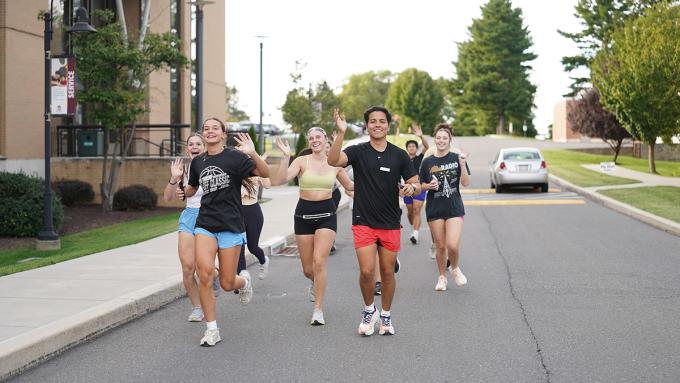
Alvernia Running Club grows through fitness and community
What started as a small group of students meeting for casual runs has grown into an increasingly active campus organization that brings Alvernia University students together through fitness, wellness, and community.
Founded by Emilio Mejia, the Alvernia Running Club provides students of all running abilities with a welcoming space to stay active, build healthy habits, and connect with others.
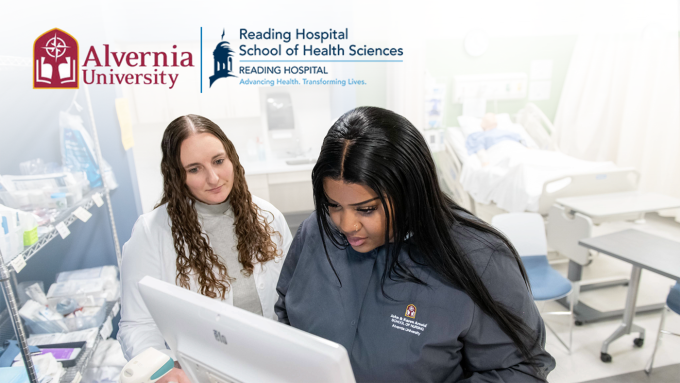
Alvernia University and Reading Hospital School of Health Sciences Renew Partnership to Expand Healthcare Education Pathways
Renewed agreement continues dual-enrollment pathways, degree opportunities and discounted bachelor’s completion options for RHSHS students
Alvernia University’s O’Pake Institute launches O’Make Space to expand student innovation and entrepreneurship
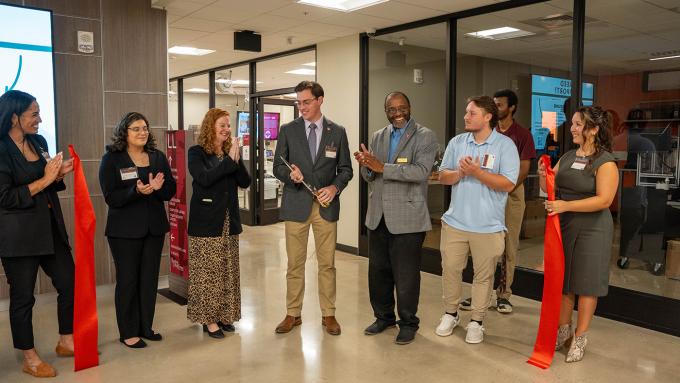
Student-driven makerspace expands Spark Business Incubator services while creating hands-on learning opportunities