
Undergraduate Major
Bachelor of Arts in Theology
Theological study long has attempted to address the most profound questions of existence and the meaning of the human religious experience. Theology courses ask these questions with attention to the universally human and particular focus on the Judeo-Christian tradition. A major in theology prepares students for further work in academe or seminary and can serve to complement another major. A minor in the discipline provides students with greater knowledge of religious questions.

Program Overview
- Application Instructions
Through a rolling admission process, prospective undergraduate students — including first-year, transfer, and international students — may apply via the Alvernia web portal or The Common Application. To learn more about how to complete your application, please visit our application page.
- Financing Your Education
There are options to assist in financing your education and making the tuition affordable. Visit our Student Financial Services page for a detailed overview of the process, including a link to complete the FAFSA application, as well as more information about tuition, the tuition payment plan and the tuition deferment program we offer. Alvernia’s Title IV code for the FAFSA is 003233. The Office of Student Financial Services is available to help with any questions you may have. Call 610-796-8201 or email sfs@alvernia.edu.
- Career Outlook
According to the Bureau of Labor Statistics, careers in which people with a theology degree are employed are expected to grow by up to 19 percent between 2022 and 2032. The median salary in the field is $45,300. After earning the Bachelor of Arts in Theology, you can pursue a variety of careers, including:- Church work
- Religious publishing house
- Diocese office
- Campus minister
- Hospital, prison or military chaplain
- Director of a church camp; pastor; priest; missionary; or religious education professional
- Community work
- Lobbyist
- Consultant
- Counselor
- Public servant
- Opportunities for Majors
Theology Club
The Theology Club is open to all students. Club members are people who want to evaluate their lives in relation to what they believe. Students have the chance to hold discussions, events, and activities.
Theta Alpha Kappa, Alpha Zeta Xi chapter
Theta Alpha Kappa is the national honors society for Religious Studies and Theology. Majors and minors in Theology with a minimum
3.5 GPA in their theology courses and a minimum 3.0 overall GPA will be inducted into the society in their final spring semester.
The Washington Center Experience
Alvernia students have an opportunity to earn college credit by spending a semester or summer in Washington, D.C. where they serve as interns in a congressional office, government agency, major corporation, newspaper or news network, or agencies devoted to legal affairs, international relations, or business and economics. They also may intern with one of several non-profit groups dealing with the environment, women’s issues, the arts, education, science, or labor relations among others. Participants are customarily juniors or seniors who have achieved grade point averages of 2.5 or better and who have the endorsement of the appropriate academic area. In addition to their internship, students select one seminar dealing with the arts and humanities, communication, public policy, the legal system, business, and government. Interested students should see their academic advisor.
- Accreditation Statements
Alvernia is an accredited institution and a member of the Middle States Commission on Higher Education. MSCHE is an institutional accrediting agency recognized by the U.S. Secretary of Education and the Council for Higher Education Accreditation.

Why Choose Alvernia?
• A rich campus life allows students to enjoy a full calendar of activities and events, more than 50 clubs, intramural sport and student leadership and governance opportunities.
• An ever-expanding number of online offerings provide flexible learning opportunities for busy professionals eager to create their educational comeback.
• Experiential learning opportunities include internships, field experiences, co-ops, research projects and study/service abroad programs.
• Highlighting our culture of care, our SOLAR (Support, Opportunity, Love, Access, and Resources) initiative aims to address every student’s academic, financial, emotional and personal needs.


Recent News
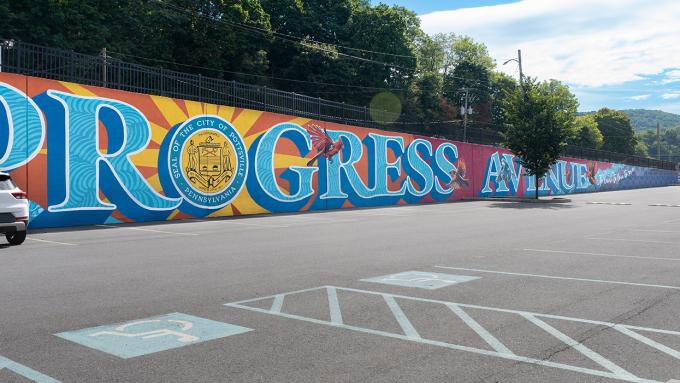
Alvernia unveils nearly 300-foot mural celebrating Schuylkill County heritage
Community art project at Pottsville CollegeTowne connects local history, creativity and collaboration
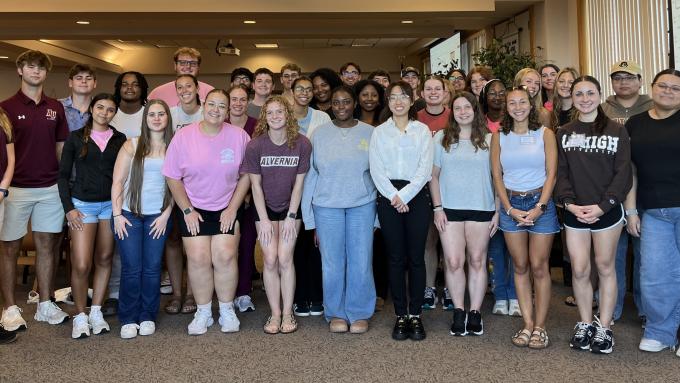
Academic Success Center Welcomes Record Number of Peer Tutors
46 students to serve their peers for the 2026-27 academic year
Alvernia Marks 25th Anniversary of Sept. 11 Through Service and Interfaith Remembrance
University launches new Franciscan Fridays service series and gathers faith and community leaders to honor the lives lost and legacy of service
